Showing posts with label Bunia. Show all posts

Tuesday, June 23, 2020

The Calm and the Storm

In March, we watched in horror and wonder as COVID-19 spread through much of the world. In DRCongo, we began to prepare and brace ourselves. But so far, there have only been 2 confirmed cases in our province, and those were months ago. So it was as if we were living in the calm before the storm. Except we had our own storm. Here’s how it all looked to us.

March 31, 2020: Coronavirus had begun to spread in the capital, Kinshasa, and there were 2 confirmed cases in Ituri province, where we live, including one in our town of Bunia. The Congolese government issued restrictions: schools, churches and restaurants were closed; public gatherings of more than 20 people were prohibited. Our administration decided to close our office. We had a final prayer meeting and said good-bye to each other.

Prayer meeting to close our office

Monday, February 17, 2020

Bonus Time (by Jennings)

This is part of a series of short posts I'm writing to reflect on what God has done in my life and how my experience with cancer -- the pressures and the opportunities -- has changed me. I hope that it may have some benefit to encourage others.
----------------------------------------------------------------------------------------------------------------
Now listen, you who say, "Today or tomorrow we will go to this or that city, spend a year there, carry on business and make money". Why, you do not even know what will happen tomorrow. What is your life? You are a mist that appears for a little while and then vanishes. Instead, you ought to say, "If it is the Lord’s will, we will live and do this or that." James 4:13-15

When I heard that my cancer had returned, as a metastasis (one to be treated "aggressively"), my whole outlook changed. Would the treatment work? Would I make it to age 53? To 60? Suddenly, planning for the future took on a new meaning... would I *have* a future, in this world? For how long? I was still reeling, emotionally, when Douglas called me from Uganda. "I have bad news." One of our dear friends in Nairobi had died of a heart attack. Out of the clear blue, at his son's soccer game. He was only 62, a runner, in excellent health, as far as we all knew. I was worried about my lifespan in terms of years... but nothing is promised to us, not the next five minutes.

Saturday, November 9, 2019

Home Sick (by Jennings)

(or "How we came to visit family in the U.S. for the holidays, and I ended up bald and living in my parents' guest room")

NB: I wrote this piece back in March 2019, when I was still reeling from the news that I had a recurrence of endometrial cancer, as a metastasis, and that I would need 4 months of chemo and radiation and might need to stay in the U.S. for 2 years. At the time, I wondered if I would ever see our home in Bunia again. My deepest fear was that our life there was over, and I was in shock at that idea. I wrote the following post in the midst of those thoughts and emotions. I'm posting it now because it expresses much of what I love about our Congolese life.
What "coming home" looks like, every day, in Bunia

Tuesday, November 20, 2018

October highlights - Conflict, Ebola and language use

In mid-October, Douglas and Bagamba were invited to the office of the Governor of Ituri Province (a few hundred yards from our office in Bunia) to participate in a meeting on the Ebola outbreak. They were asked to give advice on the best languages to use in different areas, in order to make sure people are understanding important information about the disease.
About one million people in Ituri Province speak the Lendu language. The Lendu Bible has been available for two years. Although it was produced by another organization, we knew the translators and one of them is now part of our translation consultant team. In addition, Bagamba understands the language, due to having spent part of his childhood in the Lendu area. Recently he visited a Lendu-language church service that started in Bunia a few months ago (photo above).

Services at this chapel were held only in Swahili and in French until this year, when many Lendu speakers fled to Bunia because of violence in their villages. The leaders of this church realized that many of these displaced people did not know Swahili or French, and started a third Sunday service to minister to them in their own language. This service has become very popular among Bunia residents, including among people who understand Swahili and even other local language better than Lendu!

Unlike most other denominations in Bunia, this church has the custom of confessing their faith each week using the Apostle's Creed. But Bagamba noticed that they said the creed in Swahili. They have the Bible in Lendu, but this brief but important text is not yet available in their language. Bagamba is looking into having a faithful translation of the creed prepared for use by this congregation -- and why not by others?

Thursday, July 20, 2017

The rich get richer and the poor get poorer (by Jennings)

In Matthew 13.12, Jesus says, "Whoever has will be given more, and they will have an abundance. Whoever does not have, even what they have will be taken from them." The first time I checked this with a translation team, I asked them if the saying was clear to them. Oh yes, they said, we have a similar saying in our language. Great. But in this context, Jesus is speaking in a spiritual sense, not about money. Is that how a reader/hearer would understand it? No, they would understand it to be about money. Because that is clearly true.


Saturday, August 29, 2015

Ndruna Service for Mobilization

The Ndruna New Testament has been translated and is set to be published next year! In May, our colleague Dr. Bagamba led a service at a local church, using the Ndruna language and Scriptures, to help get people excited about receiving - and using - the New Testament. They also hope to continue with the Old Testament, which will require much support from the Ndruna people.

Veteran translator shows his true feelings for the Ndruna Scriptures, before breaking into song.
The service opened with Mr. Avuta Mboudhu, who has worked his whole life translating the New Testament and hymns into Ndruna, his mother tongue. He read a passage of the translated New Testament. You can see in the photo above how excited he was, and the congregation cheered. Then he started a Ndruna praise song, and the whole room jumped to their feet to sing along, clap and dance. (**See an update at the end.)     

Friday, March 20, 2015

This Little Puppy Went to S.P. , This Little Puppy Stayed Home...

Elikya playing with her pups
In December, the day I returned from Goma (previous post), our dog Elikya had puppies! Douglas texted me when the first arrived, while I was still in the Goma airport. By the time I got home, there were 5, and by the time we went to sleep there were 6. When we woke up, there were 7!
Of course, having the puppies made for a very fun - if slightly chaotic - Christmas and New Years. Then, quite suddenly, two of them got ill and died. We think it was worms, though we're not sure. It was heartbreaking... I try not to think about it too much...
Puppies having one of their first meals, back when their ears and paws were still so tiny.
The others stayed healthy, and the first one left to go to his new home just a couple of weeks ago. The day guard at our office, who loves dogs, had picked him out of the litter because he's unique-looking, all white. He asked what the puppy's name was, and we told him that we were calling him "Whitey" (or "Le Blanc" in French... "the White One"). I asked him a few days ago how Whitey was doing. He said he is a very nice dog, "très gentil". I love that he appreciates that about him! He said that they changed his name from "Le Blanc" to "Le Bon"... "the Good One". I love that, too. I am so happy that Whitey went to this new home!
Whitey getting ready to go to his new home. Now his name is "The Good One", Le Bon.

Wednesday, May 7, 2014

Healthcare Among Friends (Part 1)


A few months ago, I (Jennings) noticed a sore on my face that wouldn't heal, and I began to be suspicious of it. Back home in the U.S., I would call or email my dermatologist to make an appointment; the spot would be removed (if needed); and the insurance company would have sorted out how much I owed (perhaps a hundred dollars or more).

Here, it works differently. Here, you use the friend network.


Friday, December 27, 2013

Snapshots of December 2013

A few photos from December in Bunia. This is a wood carving of the Nativity (it's hard to make it out in this photo, sorry) that we bought from a local artist. I had been decorating the house with Christmas cards we received from the U.S. in previous years, and I was struck at how, well, white all the figures were - the angels, Jesus, Mary. It made me appreciate all the more this depiction of Jesus in an African context, in African art.

Friday, December 20, 2013

Confronting Congolese Doubts about Local Language ("Mother Tongue") Development and Bible Translation


A few weeks ago, President Joseph Kabila came to town for a few days. Among the groups he planned an audience with was UNADI, a coalition of 21 ethnic groups. They are concerned that their parliamentary representatives (MPs) serve their party and not the people they represent. So these ethnic communities wanted their representatives to talk with the president about how they can help themselves without relying on government. They voted on 3 people to represent them in that meeting. One of them was Douglas' partner and our dear friend, Dr Bagamba Araali.

Bagamba and Douglas in front of the Bible translation office in Bunia
He and the representatives arrived where President Kabila was staying at 7 AM, as instructed. And they waited....

Monday, November 4, 2013

Musings on some signboards (by Douglas)

Back when Congo was a colony of Belgium, it was decided to use French as the language of national administration. That's why even more than fifty years after the country achieved independence, we use French every day.

But almost no one in Bunia is a mother-tongue speaker of French. That means that we encounter nuances of French usage here that we don't see anywhere else. I present as examples three signboards in our general neighborhood.

One is on a roadside restaurant run by "la Brune". This is related to the English word brunet / brunette ('brown-haired'). In France, this would mean that the woman who runs it is darker than others: at least having brown eyes and brown hair, if not tanned. Here, it means that the woman who runs it is fair-skinned by local standards, i.e. brown rather than black.

A little further down the road is a shoe-repair shop marked "Coordonnerie". The usual French word is "cordonnerie", staffed by a "cordonnier". (The English equivalent "cordwainer" is not in common use -- that's an example of my trademark understatement.) What has happened is that people have been influenced by the verb "coordonner" 'to coordinate' and the noun "coordination" (which is how one marks some offices of people who run things). You want your shoes to be repaired by a responsible and well-coordinated specialist, don't you?

Around the corner and down a block there is a "Cafétariat". This begins like "cafeteria" (an eating establishment) and ends like "Secrétariat" -- again, an office where important work gets done. So, after you drop off your shoes for the attention of the coordinated cordwainer, you can grab a bite at the high-level professional café.

There's more to many things than meets the eye...

Friday, October 4, 2013

Going for Bread Shortly After Dark (by Jennings)

There's a shop on the corner, about a 5-minute walk from our house, that sells fresh bread. We often go by at the end of the day to get a baguette or a small loaf to have with dinner and for breakfast the next day.

Generally, we try not to walk outside the compound after dark. But the bread shop is close by, on a busy street, and I'm starting to feel enough a part of the neighborhood that I don't worry too much. It's become something of a small social outing, greeting people along the way: strangers hurrying home before dark, and people doing various jobs.


A typical night's walk:

At the gate to our compound, I meet our neighbor, Daniel*, who lives in the other side of our house with his son, two dogs and four puppies. We talk about the puppies (which ones are thriving, which are not, which ones he'll give to friends, which one he'll keep); the current measles and polio vaccine program that his employer is holding in conjunction with other NGOs throughout Congo; the helicopters flying overhead, part of a military offensive against a local militia leader (not in Bunia, outside of town).

By now it is quite dark. Daniel wonders if it's a good idea for me to go out, and I say I know everyone between the house and the store, so I'll be fine. He laughs, "You're at home."

First on the path is the kiosk owned by Joe, a sweet-faced young man who always has a friendly greeting for us. We've gotten into the habit of "keeping each other's debts" - he'll let me take some oranges without paying, then when I pay he'll give me back all but 200 francs which he gives me the next time I stop by, etc. This is part of building relationships here: you help me, I help you. Trust is built.

Next, the stylish young ladies from Kinshasa who run a beauty-supply store / bar. They are always friendly, and they wonder why I feel the need to wear a skirt all the time (Congo modesty). I'm a little envious... their capris look comfy.

Then I pass the gates to a UN compound and to the local electric company. I try to always greet the night guards... they can be highly valuable friends in a time of need. ("Bon soir." "Bon soir, mama.")

Then more small kiosks, including Mama Josephine, who owns The People's Fishmongers'. She is in a choir with a good friend of mine, and we usually talk about whether or not this friend is traveling or in town.

Then the money changers, 5 or 6 of them sitting around two tables with beach umbrellas, eating fruit and drinking beer, with stacks of francs on the table and dollars hidden underneath. They're a bit of an intimidating group, but friendly. I imagine their job is not the safest, so I try to be kind. I stop to change a large US note into small notes and some Congolese francs, and we chat a bit. 

One points at my left hand: "Say, mama, why do you have two rings?" 
"One is for engagement, one is for marriage." 
"Ah."

Then a row of motorcycle taxis. I only know one of them, Jimmy (I picked him out early on because he wore a helmet, which somehow made me think he would be a safer driver, and he is), but I try to greet them all in a general way so that no one feels snubbed. Some return greetings in French, some in Lingala, some in Swahili.

Finally, I get to the bread store. One of the ladies there knows me pretty well. She'll get out a baguette for me when I walk in, and we make a little small talk. ("Mama, you really sweat a lot, don't you?") But tonight it's a different girl, and when I ask, in French, "Baguette?" She shakes her head and says "Swahili." So I make my best guess at the Swahili equivalent: "Uh... bageti?" None tonight, so I get a sliced loaf instead.

As I leave, the money changers stop me. They need more information about the two rings. Here goes: "In our culture, the man doesn't give a gift to the family of the woman he wants to marry. Instead, he gives a beautiful ring directly to the woman. Then when they marry, they give each other another another ring." 
"Ah, okay."


In front of Joe's kiosk, there are now several motorcycles and a group of men. One of them says, "Bon soir, muzungu." I still bristle a bit when people call me that, rather than "mama" or "madame", which seem more culturally appropriate. So I pretend I don't hear him. I think later what I could have said: "Bon soir, papa" (to show him that I know how to speak respectfully), or "Bon soir, Congolais" to be funny (probably unwise).

Still so much to learn. But it is deeply satisfying to feel that, at least in some ways, I know this little corner of Congo, and it knows me.

*all names are pseudonyms

Friday, October 19, 2012

Liberality, or Eat and Drink for Next Week We Go On Furlough (by Jennings)

We are privileged to live in a town where we can get a lot of the finer things in life: fresh milk, cheese, a wide variety of fruits and vegetables, bags of wheat flour for baking, oats, and household goods such as mattresses and cloth, even printer cartridges.

Still, there are some things we enjoy that we can't get here - raisins, cocoa powder, spices, crackers, zip-lock bags, chocolate - that we bring from the U.S. or buy in Nairobi or Kampala. We ration these carefully, trying to make them last until the next time we can travel to get more or have them sent in. We are ... discreet... with these; we don't leave them out where people can see them. They are for "special occasions".

This is not hoarding. It's self-control and good management of available resources. ... Okay, maybe it's hoarding.

But now, we're just three days away from an 8-month furlough. Eight months in the good ol' U.S. of A., the land of milk and honey... and chocolate, and superstores. A land replete with zip-lock bags, batteries (good ones), wholewheat flour, cinnamon and chili powder.

Suddenly, I'm feeling very liberal, very generous. Crackers? Here, have another one! Icing sugar? Time to bake a cake, and *frost* it! Happy birthday, friend! Lentils? Time to make some soup, and share it with the night guard! That last bar of Cadbury chocolate...? Let's make chocolate chip cookies ... and offer some to the neighbors! Molasses? Time for gingerbread! Employee diagnosed with typhoid and given a prescription for Cipro? Have some from our stock, it's on the house! Want some multi-vitamins with that? Wheeee!!! Glorious freedom!

So how can I foster a more care-free attitude towards things all the time? What is the proper balance between hoarding and wasting? How to manage our resources responsibly, without being selfish?

Sunday, March 11, 2012

Translation checking (by Jennings)

Gospel of Luke in a local language
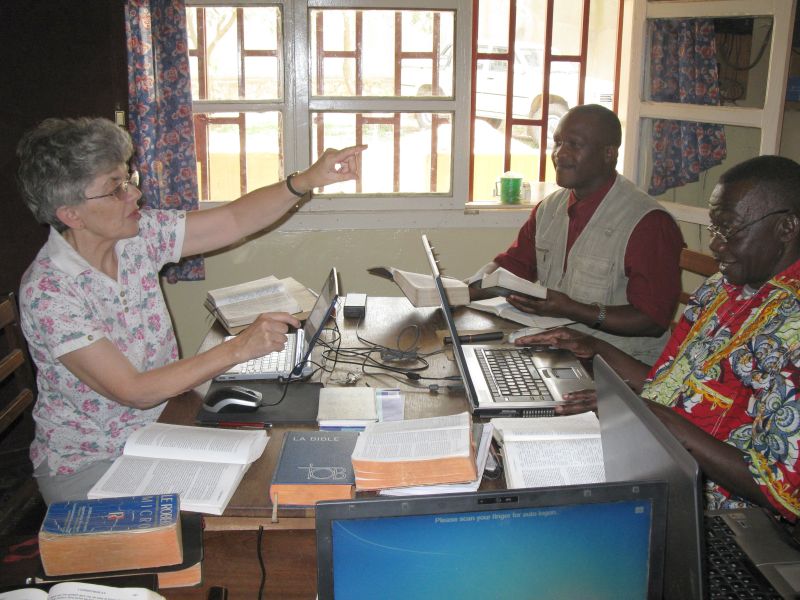
Last week, I had a rare opportunity to sit with our senior translation consultant as she worked with one of the translation teams based here in Bunia. They were doing a final check of I Corinthians. It is an incredibly hard book to translate (though not as hard, I'm told, as Romans or Hebrews). They had done an admirable job, especially considering that they didn't have access to any of the normal helps for translators - commentaries, manuals, translation guides. There is a huge amount available in English, but the French versions are coming out at a slow pace. So they had worked from the available Bible versions they have - several French versions, a Congolese Swahili version, and - most importantly - a French/Greek interlinear.

This particular team - much like the team I work with normally in Goma - are displaced from their home area because of ongoing militia activity ("activity" being a woefully mild euphemism.) They live in a part of town called the "cité", in a neighborhood comprised largely of people from their same ethnic group, many of whom have also fled to Bunia for safety. (The population of the city grew 10-fold with the 1998-2003 war.)


Once we started, the consultant was able to find electronic copies of translation guides in French - still rough drafts, but better than nothing - written by a consultant in Cameroon. These were a great help. We worked hard for a week and got through the first four chapters.

I learned a lot about working through hard material with a team. I took pages of notes about how they got to the meaning of hard verses and thought through the best way to make it understandable to their audience. Most important, I think, was the way the consultant interacted with the team. She used every opportunity to train them in how to find the answer for themselves rather than handing it to them. She scolded them when they had let something slip that they really should have caught themselves. She worked hard, and kept a positive and encouraging attitude. I think they will go on from here better equipped and, hopefully, encouraged.


As usual, some of the most memorable moments came during break times, especially mid-morning tea. I asked them how things were in their hometown. They said people had gotten so used to gunfire that they hardly flinched when they heard it. In fact, they laugh at people who are startled by it. But, they do always check to see what it's about. If, for example, it's because some guy wanted someone to give him a kilo of meat and he was refused and got mad and shot his gun, then no worries. But if it's something that might actually be a threat to them, they grab their suitcases and run.

Last year, for a colleague's birthday, I baked a chocolate cake and took pieces around for all the translators. These guys were very impressed and said it was the kind of thing they would only eat at a wedding. (Baked goods are rare here - few people have ovens, and flour and sugar are expensive.) So on Tuesday I made muffins for them. They were very pleased, so I made some on Friday as well. They asked, is there banana inside? yes. One of them recalled that the cake I brought last year was sort of... brown...? Ah yes, I said. That was chocolate. Ah, yes, chocolate!

The last morning, around 9:00, one of the translators got a phone call from the chief of the cité, saying that he had to meet him at the round-about at the entrance to town at 10:00. Sharp. Like the other translators, he is a pastor. They are often called upon to help in political matters, to mediate disputes, etc. He had to rush home to get his good suit so he could be at the appointed spot in time. We were reminded that, even though these men are full-time translators, they have pastoral responsibilities that go way beyond what we realize.

It is humbling to work with them, and it encourages me to want to be the best consultant I can.

Friday, January 6, 2012

Slices of Life in December

Here are just a few highlights from the last weeks of December:

Dancing:  Our friends hosted a Christmas recital, of various adults and children singing, playing piano, and reciting Scripture.  The highlight for us: two, adorable five-year-old girls gave a (very short) ballet recital in beautiful pink tutus.  They had been taking lessons with me for several weeks, learning some of the basics and playing games like "Doll Shop" and "Mermaids".  Such fun!

Shopping: My friend Suzanne who works with MAF (and has a vehicle) took me to the big market across town.  I bought an electric burner (electricity, while irregular, is much cheaper than the gas we normally use for cooking) and a piece of cloth for a new dress.  Suzanne handed out Christmas gifts to the merchants she knows best: bottles of highly-prized palm oil. (I thought that was a wonderful idea.)  We also saw an evangelist, standing in the middle of the rows of shops, shouting at the top of his lungs (in Swahili, so I didn't understand much.)  I tried to keep a low profile as I walked by him.  But I did notice he had very clean, white, pointy-toed shoes.

We also bought a pair of carved elephant candle holders from Papa Joseph, an artist who visits us regularly to show us what he has to offer.


Saturday, April 23, 2011

Hospitality (Or, Walls and Umbrellas)

Last week we had a special tea time at the translation office in town. We were saying good-bye to an American volunteer (now a dear friend) who spent 3 months here helping to refurbish the office and to start some new building work.  Three translation teams use the office, plus our group.  The office will serve everyone's needs much better when it is completed.  It already looks much, much better.

The first job was to build an enclosure wall around the compound.  The office is on a busy corner, both for foot traffic and vehicles, and pedestrians often cut through the yard.  The wall keeps out potential thieves, as well as (some of) the dust and noise from the road.

During the tea time, one of the translators bemoaned the loss of "la culture africaine", as more and more people put up these enclosures. Traditionally, during a rainstorm, people would welcome in passing strangers to wait out the storm so they wouldn't get wet.  But now, with these enclosures, there is no place for people to take shelter, and the traditional hospitality is lost. A couple of months ago there was a very heavy hailstorm, and a man was knocked down and nearly blacked out just outside the office.  People inside saw him, somehow, and went to help him.  But if the wall had not been there, he could have come in and taken shelter in the building, and perhaps he would not have been so hurt.

We were struck by the hospitality of this tradition of giving shelter to passers-by.  In typical, self-sufficient American fashion, we carry our own shelter around with us, in the form of umbrellas.  It would never occur to us to ask someone to let us into their house in during a simple rain shower.  Self-sufficiency is not a high value in Congo; community is. 

Tuesday, January 25, 2011

Our "Top Ten Things We Love About Living in Bunia" List


1. The People - We have dear, close friends here, both expatriate and Congolese.  We are constantly touched and humbled by how generous people are with their time and resources.
Two of our American friends made and decorated this gorgeous cake when we arrived in July.

2. The Clothes - Congolese women and men love bright, colorful patterns. Most women here wear traditional African cloth outfits, especially to church or on a special occasion. Tailoring is truly an art form. We have a particular tailor that we like, and he has made nice outfits for both of us (below). People literally stop us in the street to say how marvelous we look. They seem to love the fact that we appreciate Congolese fashion enough to wear it ourselves.
Janvier in his shop, tailoring a skirt for Jennings

Our Christmas outfits
It's always fun to see the different styles and designs that people wear.  And spotting a burly young man with a hot pink, tasseled messenger bag or a lavender "My Little Pony" backpack... that can just make your day.
Members of a choir often have outfits of matching cloth, but with individual style
An impromptu photo calls for just a bit of "spiffing up".

3. Singing - On a Sunday morning, there can be 4 or 5 different local choirs performing at church: full-throated, exuberant singing, with choreographed movements.  Generally the songs are in Lingala or Swahili, but sometimes they are in French. Thrilling!

4. Rainstorms - We get *serious* rainstorms here - drenching, full-on downpours, complete with thunder and lightning. They come down from the Blue Mountains, pushing delicious cool breezes in front of them. Wonderful!

5. The sunsets - stunning!!! (... we have not yet seen so many sunrises)

6. Goma cheese - Surprise! We get better cheese here than we did in Nairobi! Goma cheese (from the North Kivu region) comes in one-kilo rounds and is great "as is" or melted on stuff. It can fill in for many varieties of Western cheese to make grilled cheese sandwiches, pizza, lasagna, you name it. It is one of the brightest spots in our meals here.

7. Fresh produce - Passion fruit and papaya from the market, pineapple from our friends' garden, different kinds of local greens (leafy vegetables)... we love them all! Passion fruit is great by itself, and it also makes delicious juice.
Still life with Goma cheese and passion fruit
Those aren't hats on the kids' heads; they're to help them balance baskets of corn.

8. Fresh milk - Delivered to the front gate: just boil, skim and drink! Collect the cream and whip into butter! One of the advantages of living in a cow-raising region.

9. Slow walking - When the sun is high during dry season, it can be hot out there, and dusty. You do *not* want to be trying to rush somewhere, working yourself into a sweat (and kicking up dust clouds).  Plus, the roads and paths are far from even, and you might twist your ankle if you aren't careful. So just take your time. Sloooow down. Amble. Look around you... that's how everyone walks! And they're right! Greet people, breathe, relax... now, isn't that better?

10. The "Being There" Factor - When we first arrived, Congolese would ask how long we were going to be here, assuming we were visiting.  When we answered "Nous sommes là!" ("We are here!"), we were rewarded with huge smiles and vigorous handshakes.  There is something very fundamental about sharing life together, about being in the same place, being part of their lives, experiencing (a very small part of) the struggles they experience.  It's more than physical presence, it's solidarity, empathy.  It's a high value here.   "Tuko pamoja"... "We are together".

Saturday, December 11, 2010

Je ne réponds pas au nom de "Muzungu" (My name is not "Muzungu") - by Jennings

My biggest emotional challenge here is getting used to being so conspicuous.  There is simply no “blending in” in a public setting.  Conversely, my happiest moments are here are when I really do feel a part of things, when I am with Congolese who know me well enough to be completely unimpressed by my presence, who treat me as a friend. Those warm, wonderful moments of feeling part of the group, connected, at home. Like I belong here.

I have an ongoing internal debate over the word “muzungu” (the Swahili term for a foreigner, specially a white foreigner).  Like many epithets, I don’t mind using it about myself in a self-deprecating joke, i.e. “Ah, we wazungu are so feeble, we have to drink filtered water or we get sick! And our skin is so weak that we have to cover it from the sun or we’ll turn into nyama choma (roasted meat).”  But I bristle when someone yells it at me.  Which happens all the time.  Children in particular, if they see us walking down a road, come running, pointing and yelling “Muzungu! Muzungu!”  Vendors in the market yell it at us, as do motorcycle taxi drivers.

One strategy is to smile and wave, like a celebrity being yelled at by fans.  (Though usually I feel more like a clown with a huge red nose and floppy shoes that everyone has come to point and laugh at. I obligingly wave and smile, aware that, indeed, I am quite the spectacle.)  Another strategy is to ignore it, as if the kids are being impolite and should not be encouraged. Or to try and encourage them to be more polite by setting a good example, responding with “Jambo!” or “Bonjour!”… you know, the way you greet an actual *human being*, not some kind of walking freak show. (Ahem... pardon the strong feeling there.)

As with most things, getting angry is never the solution.  Humor is always, always better. A few nights ago, I was walking home alone after dark - NOT a good idea! - and had the following exchange (translated from French).  Two guys passed me from behind and one said (without really looking at me) "Muzungu, muzungu, good evening!"  I immediately prickled and said nothing. But, aware of my vulnerability, I also didn't want to offend and make them mad.  Causing someone to lose face in public (such as by ignoring them) is not especially wise. So I tried joking to veil my anger: "That's not a name! Shouldn't you say 'Good evening, madame'?"  They answered, "But you're a muzungu, right? You're a muzungu!"  "Okay, yes. But would you like it if I said, 'Good evening, Congolese'?"  "Yes, that's good, we would like that!"  Then the conversation took a new direction: "So, where you going? Do you live around here?"  I started thinking how I could end it and not have them follow me down the darkening street.  Thankfully, a Congolese friend and his daughter appeared just then, and escorted me home, and the two guys faded into the night. I had fun telling our friend's 7-year-old son how his Daddy and sister had saved me from the bad guys (using great exaggeration, which is completely fine with kids).

I am trying now to be more positive about being yelled at and being called "muzungu".  I'm trying to interpret it as a sign that they are glad I’m there and want to connect with me in some way.  And I think this is very often the case.  So I try not to take offense.  If someone greets me with “Jambo, muzungu!” that is at least more polite than just pointing and staring or yelling. “Bonjour, madame” is even better, and I'll always answer... it would be very rude to ignore a greeting like that.

And “Jambo, mama!”… that is probably my favorite. It has an affectionate feeling, almost like they see me as someone who belongs here. :)